Elvas vai acolher duas conferências e um concerto, no âmbito das XVIII Jornadas Internacionais “Escola de Música da Sé de Évora", organizadas pela Associação Eborae Mvsica. A iniciativa decorre em Évora, no Convento dos Remédios e na Sé de Évora, entre 2 e 4 de Outubro, e em Elvas, na Biblioteca Municipal e Sé de Elvas, a 6 de Outubro.Assim sendo, pelas 17 horas, de sábado, dia 6, na Biblioteca Municipal de Elvas Dra. Elsa Grilo, decorre as conferências “Relações Musicais entre a Sé de Évora e a Sé de Elvas” e “Passagem, de Manuel Joaquim por Elvas”.À noite, pelas 21 horas, concerto pelo Coro Polifónico “EBORAE MVSICA”, sob direcção do maestro Eduardo Martins, na Igreja de Nossa Senhora da Assunção, antiga Sé de Elvas.Estas jornadas têm como objectivos divulgar o espólio da Escola de Música da Sé de Évora, dos séculos XVI e XVII, de Frei Manuel Cardoso, Duarte Lobo, Diogo Dias Melgaz, Estêvão Lopes Morago, Filipe de Magalhães e outros; dar a conhecer formas de abordagem diferentes deste reportório; aprofundar técnicas vocais de interpretação; criar um espaço de intercâmbio de saberes, vivências e culturas; criar um espaço de abertura à participação da Comunidade.Os destinatários da iniciativa são directores de coros, membros de coros, profissionais e amadores de canto, professores de música e outros interessados.
Este site dedica-se às aves e a relação com o Homem. O canto do Canário Timbrado, Canário Harz Roller, do canário Malinois e outros canários.. O objectivo de site é contar as aventuras e os arcos de descobertas relacionados com Homem e as aves. This site is dedicated to birds.singing canaries song,canaries,canaries de chant. carmelita=carmelo=jardim
Mostrar mensagens com a etiqueta Elvas. Mostrar todas as mensagens
2 de outubro de 2018
12 de março de 2018
5 de março de 2018
25 de fevereiro de 2018
23 de fevereiro de 2018
Elvas- Estação de comboios
- Morada: Largo da Estação, Fontainhas, 7350-225, Elvas
- Coordenadas: 38.895657|-7.1422613
- Serviços CP: Regional e InterRegional
- Linhas: Linha do Leste
Elvas
The site, extensively fortified from the 17th to 19th centuries, represents the largest bulwarked dry-ditch system in the world. Within its walls, the town contains barracks and other military buildings as well as churches and monasteries. While Elvas contains remains dating back to the 10th century ad, its fortification began when Portugal regained independence in 1640. The fortifications designed by Dutch Jesuit padre Cosmander represent the best surviving example of the Dutch school of fortifications anywhere. The site also contains the Amoreira aqueduct, built to enable the stronghold to withstand lengthy sieges.
Outstanding Universal Value
Brief synthesis
Guarding the key border crossing between Portugal’s capital Lisbon and Spain’s capital Madrid, in an undulating, riverine landscape, the Garrison Town of Elvas was fortified extensively from the 17th to the 19th centuries to become the largest bulwarked dry ditch system in the world, with outlying forts built on surrounding hills to accommodate the changing needs of defensive warfare.
The town was supplied with water by the 7km-long Amoreira Aqueduct, built in the late 16th and early 17th centuries and a key feature enabling the stronghold to withstand a lengthy siege. Within the walls, the town contains extensive barracks and other military buildings, as well as churches and monasteries, some adapted to military functions. The property includes seven components: the Historic Centre, the Amoreira Aqueduct, the Fort of Santa Luzia, and the covered way linking it to the Historic Centre, the Fort of Graça, and the Fortlets of São Mamede, São Pedro and São Domingos.
The historic centre with its castle, remnant walls and civil and religious buildings demonstrate the development of Elvas as three successive walled towns from the 10th to the 14th century and its subsequent incorporation into the major fortification works of the Portuguese War of the Restoration period (1641-68), when a wide range of military buildings were built for its role as a garrison town.
The bulwarked fortifications of the town and the outlying Fort of Santa Luzia and Graça and fortlets of São Mamede, São Pedro and São Domingos reflect the evolution of the Dutch system of fortification into an outstanding dry-ditch defence system.
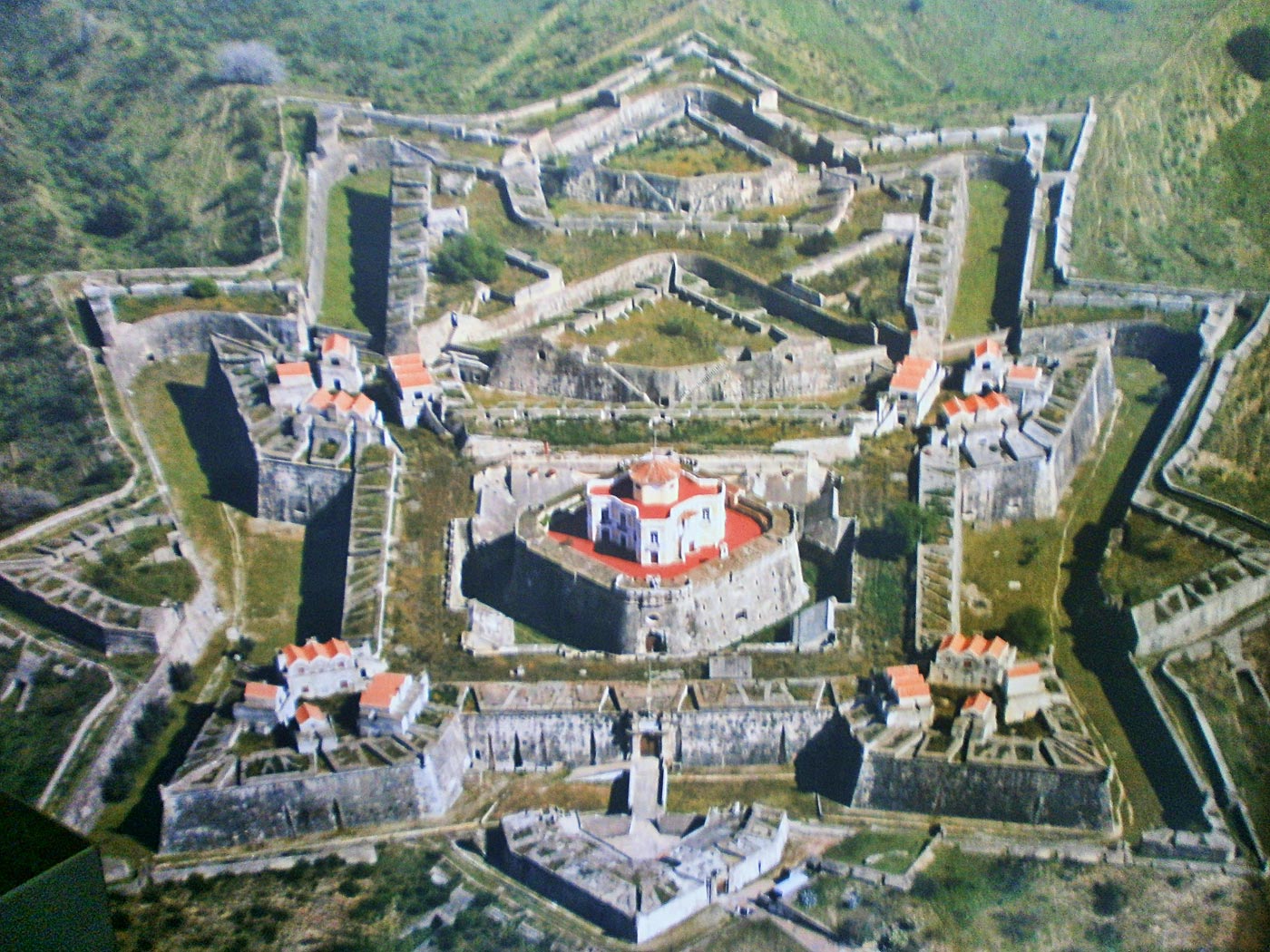
These surviving fortifications were begun in 1643 and comprise twelve forts inserted in an irregular polygon, roughly centred on the castle and making use of a landscape of hills. The bulwarks are battered, surrounded by a dry ditch and counterscarp and further protected by a number of ravelins. The fortifications were designed by the Dutch Jesuit Cosmander, based on the treaties of fortification engineer Samuel Marolois, whose work together with that of Simon Stevin and Adam Fritach launched the Dutch school of fortification worldwide. Cosmander applied the geometric theory of Marolois to the irregular topography of Elvas, to produce a defensive system considered a masterpiece of its time.
In the 18th century the Fort of Graça was constructed in response to the development of longer-range artillery, as well as four fortlets to the west.
As the remains of an enormous war fortress, Elvas is exceptional as a military landscape with visual and functional relationships between its fortifications, representing developments in military architecture and technology drawn from Dutch, Italian, French and English military theory and practice. Elvas is an outstanding demonstration of Portugal’s desire for land and autonomy, and the universal aspirations of European nation States in the 16th-17th centuries.
Criterion (iv) : Elvas is an outstanding example of a garrison town and its dry-ditched bulwarked defence system, which developed in response to disruptions in the balance of power within 17th century Europe. Elvas can thus be seen as representing the universal aspirations of European nation States in the 16th-17th centuries for autonomy and land.
Integrity
All elements necessary to express the Outstanding Universal Value of the property are included within the property boundary. A number of buildings are unoccupied and are closed up against squatters and vandalism, and are subject to encroachment by vegetation. In particular the Fort of Graça, being relatively isolated and unused is vulnerable to vandalism. Views of the fortifications from a distance and between each other are vulnerable to new development and the visual integrity of the property needs to be protected by a slightly enlarged buffer zone with adequate controls.
Authenticity
The large collection of original plans and drawings, military reports, photographs and descriptions testify to the authenticity of the property. Overall, the form and materials of the fortifications are still in virtually the same state as when they were rendered obsolete in the 19th century. The military and religious buildings have largely retained their function or another appropriate use until the present. The authenticity of the setting is impacted by large communication masts and is vulnerable to new development.
Protection and management requirements
The property will be declared a National Monument subject to the National Law No. 107/2001 on Cultural Heritage by the end of 2012. The buffer zone will be declared a Special Protection Area subject to controls in the Municipal Master Plan by the end of 2012. This whole area including the property will then be managed by the Municipality with input from the Ministry of Culture through IGESPAR.
There is a need to slightly enlarge the buffer zone to protect the views between the Fortlet of Sāo Domingo and the Fort of Graça.
The Integrated Management Plan for the Fortifications of Elvas (IMPFE) aims to bring all stakeholders together to ensure the integrity of the property and enhance its potential use. It aims to control the buffer zone area as well as the area of the property, focusing on institutional cooperation, involvement of private stakeholders, educational, scientific and cultural initiatives and dissemination of information. The Management Plan will be implemented by the Office for the Fortifications of Elvas within the city of Elvas, once this is appointed by the Mayor.
In order to underpin the Plan there is a need to establish a full inventory of the features and structures as a basis for management and monitoring. There is also a need for the preparation of guidance on appropriate design for new and infill buildings.
more in Unesco
Outstanding Universal Value
Brief synthesis
Guarding the key border crossing between Portugal’s capital Lisbon and Spain’s capital Madrid, in an undulating, riverine landscape, the Garrison Town of Elvas was fortified extensively from the 17th to the 19th centuries to become the largest bulwarked dry ditch system in the world, with outlying forts built on surrounding hills to accommodate the changing needs of defensive warfare.
The town was supplied with water by the 7km-long Amoreira Aqueduct, built in the late 16th and early 17th centuries and a key feature enabling the stronghold to withstand a lengthy siege. Within the walls, the town contains extensive barracks and other military buildings, as well as churches and monasteries, some adapted to military functions. The property includes seven components: the Historic Centre, the Amoreira Aqueduct, the Fort of Santa Luzia, and the covered way linking it to the Historic Centre, the Fort of Graça, and the Fortlets of São Mamede, São Pedro and São Domingos.
The historic centre with its castle, remnant walls and civil and religious buildings demonstrate the development of Elvas as three successive walled towns from the 10th to the 14th century and its subsequent incorporation into the major fortification works of the Portuguese War of the Restoration period (1641-68), when a wide range of military buildings were built for its role as a garrison town.
The bulwarked fortifications of the town and the outlying Fort of Santa Luzia and Graça and fortlets of São Mamede, São Pedro and São Domingos reflect the evolution of the Dutch system of fortification into an outstanding dry-ditch defence system.
These surviving fortifications were begun in 1643 and comprise twelve forts inserted in an irregular polygon, roughly centred on the castle and making use of a landscape of hills. The bulwarks are battered, surrounded by a dry ditch and counterscarp and further protected by a number of ravelins. The fortifications were designed by the Dutch Jesuit Cosmander, based on the treaties of fortification engineer Samuel Marolois, whose work together with that of Simon Stevin and Adam Fritach launched the Dutch school of fortification worldwide. Cosmander applied the geometric theory of Marolois to the irregular topography of Elvas, to produce a defensive system considered a masterpiece of its time.
In the 18th century the Fort of Graça was constructed in response to the development of longer-range artillery, as well as four fortlets to the west.
As the remains of an enormous war fortress, Elvas is exceptional as a military landscape with visual and functional relationships between its fortifications, representing developments in military architecture and technology drawn from Dutch, Italian, French and English military theory and practice. Elvas is an outstanding demonstration of Portugal’s desire for land and autonomy, and the universal aspirations of European nation States in the 16th-17th centuries.
Criterion (iv) : Elvas is an outstanding example of a garrison town and its dry-ditched bulwarked defence system, which developed in response to disruptions in the balance of power within 17th century Europe. Elvas can thus be seen as representing the universal aspirations of European nation States in the 16th-17th centuries for autonomy and land.
Integrity
All elements necessary to express the Outstanding Universal Value of the property are included within the property boundary. A number of buildings are unoccupied and are closed up against squatters and vandalism, and are subject to encroachment by vegetation. In particular the Fort of Graça, being relatively isolated and unused is vulnerable to vandalism. Views of the fortifications from a distance and between each other are vulnerable to new development and the visual integrity of the property needs to be protected by a slightly enlarged buffer zone with adequate controls.
Authenticity
The large collection of original plans and drawings, military reports, photographs and descriptions testify to the authenticity of the property. Overall, the form and materials of the fortifications are still in virtually the same state as when they were rendered obsolete in the 19th century. The military and religious buildings have largely retained their function or another appropriate use until the present. The authenticity of the setting is impacted by large communication masts and is vulnerable to new development.
Protection and management requirements
The property will be declared a National Monument subject to the National Law No. 107/2001 on Cultural Heritage by the end of 2012. The buffer zone will be declared a Special Protection Area subject to controls in the Municipal Master Plan by the end of 2012. This whole area including the property will then be managed by the Municipality with input from the Ministry of Culture through IGESPAR.
There is a need to slightly enlarge the buffer zone to protect the views between the Fortlet of Sāo Domingo and the Fort of Graça.
The Integrated Management Plan for the Fortifications of Elvas (IMPFE) aims to bring all stakeholders together to ensure the integrity of the property and enhance its potential use. It aims to control the buffer zone area as well as the area of the property, focusing on institutional cooperation, involvement of private stakeholders, educational, scientific and cultural initiatives and dissemination of information. The Management Plan will be implemented by the Office for the Fortifications of Elvas within the city of Elvas, once this is appointed by the Mayor.
In order to underpin the Plan there is a need to establish a full inventory of the features and structures as a basis for management and monitoring. There is also a need for the preparation of guidance on appropriate design for new and infill buildings.
more in Unesco
Elvas

A candidatura de Elvas a Património Mundial foi um processo que a Câmara Municipal de Elvas encetou na sequência do magnífico património cultural que a cidade possui. Depois de recuperar grande parte do património da cidade, requalificar e revitalizar o centro histórico com diversos projectos socioculturais, esta candidatura surgiu como uma das grandes apostas da Câmara Municipal para a cidade e concelho.
Esta era uma oportunidade de excelência para afirmar e valorizar todo o processo de recuperação patrimonial feito pela Câmara Municipal nos últimos anos. Em 2004, a autarquia apresentou a candidatura à Lista Indicativa Nacional do Património Mundial e foi integrada nesse mesmo ano.
Depois de anos de trabalho científico, a apresentação pública do trabalho técnico foi feita em Elvas, a 23 de maio de 2009. O dossier de candidatura foi entregue pela câmara à Comissão Nacional da Unesco em 18 de Janeiro de 2010 e aceite pelo Comité de Património Mundial da UNESCO em 1 de Março de 2011.
Todo este trabalho, assim como a cidade, foram avaliados pelo ICOMOS, órgão consultor da UNESCO, em matéria de conservação e proteção do património em setembro de 2011. Finalmente, a 30 de junho de 2012, a candidatura de Elvas a Património Mundial foi aprovada por unanimidade pelo Comité do Património Mundial da UNESCO.
“Cidade-Quartel Fronteiriça de Elvas e suas Fortificações”, a UNESCO considerou o valor universal deste conjunto patrimonial, numa área de 179 hectares, com uma área de proteção de 690 hectares, protegendo assim todo o espaço em redor das fortificações.
Sendo a maior fortificação abaluartada terrestre do mundo, a classificação contempla sete componentes: o Centro Histórico, que integra as duas cinturas de Muralhas Árabes; a cintura de Muralhas Fernandina e a Cintura de Muralhas Seiscentistas; o Aqueduto da Amoreira; Forte de Santa Luzia; Forte da Graça; Fortins de São Mamede, São Pedro e São Domingos, que refletem um pouco a evolução do sistema de fortificação abaluartada terrestre holandês.
Critério
Elvas é um excelente exemplo de uma cidade quartel e o seu sistema terrestre de fortificações surgiu em resposta às perturbações no equilíbrio de poder no século XVII na Europa. Elvas pode, assim, ser vista como representando as aspirações universais de Nações Europeias nos séculos XVI e XVII.
Integridade
Todos os elementos necessários para expressar o “Valor Universal Excecional” da propriedade estão incluídos dentro do limite de proteção. Além disso, alguns edifícios estão desocupados e fechados contra ocupantes e vandalismo, e estão sujeitas à propagação da vegetação. Em particular, o Forte da Graça, que sendo relativamente isolado e sem uso, é vulnerável ao vandalismo. O monumento nacional, após obras de reabilitação e requalificação, abriu portas ao público no passado mês de novembro de 2015, podendo ser visitado de terça-feira a domingo, das 10 às 17 horas.
Os espaços entre as fortificações e a distância entre si são vulneráveis a um novo desenvolvimento e a integridade visual da propriedade tem de ser protegida por uma zona tampão ligeiramente alargada, com controlos adequados.
Autenticidade
A grande coleção de planos e desenhos originais, relatórios militares,fotografias e descrições atestam a autenticidade da propriedade. No geral, a forma e os materiais das fortificações ainda estão em estado praticamente igual, a quando estavam obsoletos no século XIX. Os edifícios militares e religiosos em grande parte mantiveram a sua função ou outro uso apropriado até ao dia de hoje. A autenticidade da configuração tem mais impacto pelos grandes mastros de comunicação e é vulnerável a um novo desenvolvimento.
Proteção e Gestão
A propriedade foi declarada como Monumento Nacional segundo a Lei Nº107/2001, como Património Cultural no final de 2012. A zona de proteção foi declarada Área Especial de Proteção, de acordo com o Plano Diretor Municipal no final de 2012. Esta área, incluindo a propriedade, é gerida pela Câmara Municipal de Elvas, em parceria com o Ministério da Cultura através do IGESPAR. Houve a necessidade de ampliar um pouco da zona tampão, para proteger as zonas de visão entre o Fortim de São Domingos e o Forte da Graça.
O Plano de Gestão Integrada para os Fortificações de Elvas (IMPFE) tem como objetivo unir todas as partes interessadas para garantir a integridade da propriedade e aumentar o seu potencial de uso. Destina-se a controlar a área de zona tampão, bem como a área da propriedade, com foco na cooperação institucional, envolvimento dos agentes privados, iniciativas educacionais, científicas e culturais e divulgação de informação.
A fim de apoiar o Plano existe a necessidade de se estabelecer um inventário completo das características e estruturas, como base para a sua gestão e monitorização. Há também uma necessidade para a preparação de orientação sobre a conceção apropriada para edifícios novos e enchimento.
Os Elvenses estão orgulhosos pela classificação de Elvas e das suas fortificações como Património Mundial; tal foi fruto de muito trabalho, mas que não terminou com a denominação, pois cabe a todos, residentes e visitantes, participar neste esforço para preservar este património.
16 de dezembro de 2013
30 de outubro de 2013
Subscrever:
Mensagens (Atom)